Dec 12, 2012

Results from the Morocco expedition

After we came home from Morocco and got used to -10 degrees and snow, the long dark evenings was used to punch the gull readings in excel. This work was more extensive than expected, which of course is most joyful. The total number of readings was about 735 of 367 different individuals. The e-mails with observations are at the moment sent to the different project managers and we are really looking forward to get the life histories and ringing informations. When this information is received and we have done some computing we will give a summary of the results as a post on this blog! The summary for the different 'countries' are as follows:

Country Observations Number ind.
Norway 231 99
The Netherlands 150 79
England 80 38
Belgium 71 37
Denmark 54 28
Spain 28 28*
Guernsey 25 10
Scotland 19 8
France 17 6
Germany 14 6
Iceland 9 4
Portugal 4 1
Sweden 1 1**
Unknown 32 22
*27 Audouin's Gulls and one Black-headed Gull
**Reading of metall ring

The species was dominated by Lesser Black-backed gull (Larus fuscus) followed by Audouin's Gull (Larus audouinii)
Species Observations Number ind.
Lesser Black-backed gull 706 338
Audouin's Gull 27 27
Mediterranean Gull 1 1
Black-headed Gull 1 1

We will end this blog with a picture of the reading that in our opinion was the best for us. This male Lesser Black-backed Gull JA8K was ringed on top of the Science building at University of Bergen. He incubated on three eggs but we do unfortunately not know who his girlfriend is. If he stick to her one more year we hopefully get more information in 2013. This picture was taken on the last observation date in Bergen 20th of August 2012.

Nov 25, 2012

Norwegian invasion in Anza

This morning we decided to start in Souss which turned out to be a waste of daylight. The best place on this site was partly made into a new road and reduced in size. We did not see any Lesser Black-backed Gull sitting, the few we saw was flying over. We quickly changed the plan and went straight to Anza. We arrived around 08:30 and before one hour had gone, over 20 different Norwegian ringed gulls had been seen. In the end of the day the number of gulls with Norwegian origin was impressive 52 different birds. This number is new high of Norwegian LBBGs recorded in Morocco in  a single day! The previous record was 48 from 27.01.2009 when two different teams were here. The total number of Norwegian ringed LBBGs on our trip is now 86. The total number of rings read today is between 150 and 160. Today the first urban gull ringed in Bergen appeared in Anza, finally! After almost 40 hours in the fish odor in Anza, J8Y0 was sitting on the beach. Another bird we appreciated was J4Z3, which we saw in one of our urban lakes in Bergen earlier this spring. This bird was ringed at Karmøy south of Bergen by Karmøy ringing group.

A local man in Anza came with these rings to us and told us he had found them on dead gulls on the beach. We will report them to the correct ringing scheme when we come home.


JR2Y is ringed as a pullus in Troms by Morten Helberg in 2012.

2.VO is ringed by Paul Veron on Guernsey

Nov 24, 2012

Yet another day in Anza

As the two previous days, we followed the same schedule and took the beach in Agadir from 07:00 to about 08:00 and the rest of the day in Anza. As you can see from the pictures below the number of gulls were fantastic. It's almost impossible to estimate numbers. The total result was a bit lower than the previous days with around 130 readings. Of these 41 had Norwegian rings which is a new high for us on this trip. This means that over 1/3 of the Lesser Black-backed Gulls with rings in Anza are ringed in Norway. On our three days in Anza we have also experienced that the time between 16:00 and dusk is the time many new gulls come to feed, especially adults. Some of the old ones have only been seen briefly during these hours. The bird on the picture above (JP2R) ruled the river with fish remains Anza. It was ringed at an island south of Mandal this year by two of the persons responsible for the domination of Norwegian rings in Anza today, Morten Helberg and Finn Jørgensen. We also had two other birds ringed on the same island on the same day, which is impressive!


Our view in Anza today, really impressive numbers of gulls


This first year LBBG 4AP5 is ringed by Paul Veron at Guernsey
J271 is ringed in a fuscus fuscus colony in Northern Norway and could possibly be and individual of this subspecies which has a western wintering site.

V.R6J is ringed in Denmark


Nov 23, 2012

Anza delivers again

Yesterday evening the plan for this day was already set. Agadir beach in the morning and the rest of the day in Anza. We followed this plan and got awarded with around 130 readings of Lesser Black-backed Gulls (Larus fuscus).  Some of these are the same as yesterday, but not as much as expected. The turnover of gulls in Anza is large and we think that even after 22 hours spent in Anza, tomorrow will give us new birds. We have summarized the Norwegian birds and we have got a total of 55 different LBBGs! Two of todays highlights were a leucistic Lesser Black-backed Gull and the long awaited own ringed LBBG. 10 minutes before dusk J3Y5 was sitting in the dirty water coming out of the fish factory. This bird is ringed as a pullus in 2010 in our monitoring colony at Lyngøy in Hordaland. It was also seen in Blaringhem in France by Harry Vercruijsse earlier this year.

Leucistic Lesser Black-backed Gull
905N from France


JV4C ringed as a first year bird in Kolbotnvannet, Norway


J0K6 ringed as pullus in Lindesnes, Norway has lost a foot

5.M is one of 16 different birds we have read from this project.


J3Y5 the long awaited own ringed LBBG from Lyngøy


Nov 22, 2012

Crazy day in Anza

The first day in Agadir started before dusk and ended in dawn after gull watching in 11 hours. We stared on the beach in Agadir and quickly got ten readings before people, and dogs started their morning  exercise. The next 10 hours was spent in Anza where the gulls was numerous today. In total we read around 140 different Lesser Black-backed gulls (Larus fuscus) including 39 from Norway. One of the highlights was JU04 which we also saw in Anza this spring and found in May at our local site on the island of Fedje. Today this bird was once more sitting in Anza eating the fish remains from the fish factory in Anza. Hopefully tomorrow will give us even more readings. We end this post with some pictures.

T.4 probably from The Netherlands

JH9N ringed by Morten fuscus Helberg in Mandal this summer.

V4TC ringed by Pedersen in Denmark

Some are more colour full than others like this one, E and F85

1U9:C the ringing country is unknown for us

Nov 20, 2012

Finally arrived in Anza

After 16 hours of travel from Bergen via Oslo to Marrakesh and the two hours drive over the High Atlas to Agadir we finally arrived in Anza, Agadir. Here we could enjoy thousands of gulls. We arrived 30 minutes before sunset and could see the huge swarms of gulls over the fishing port. When we arrived in Anza we estimated the number to be between 10.000 - 15.000 gulls, impressive! We put up the telescopes and it did not take long before we had the first ringed Lesser Black-backed gull (Larus fuscus). It was a white ring probably ringed in France. After it became to dark and we had to drive back to Agadir. Now we are really looking forward what tomorrow can bring.


Oct 9, 2012

Two gulls from northwestern Norway


The 26th of September (This post is published after some delay) was spent on the western islands looking for eastern rarities. The first thing we did was feeding out a bag of bread and start to scan gull feet for color rings, once a gull addict always a gull addict. It did not take long before the first Herring Gull (Larus argentatus) with a black JN was spotted. It was ringed on the island of Fedje earlier this spring, so this one was quite ordinary. The next one was much better a fact we knew right away because it was a 1 cy Great Black-backed Gull (Larus marinus) which we have ringed only a few of this year. We suspected that this was the ringing work of Ingar Støyle Bringsvor (blog is in Norwegian). When the number was typed into the database well at home our suspicion proved to be correct. The eastern rarities was absent but this gull made our day.

JP954 was ringed in a breeding colony at Sand in Møre og Romsdal concil 176 kilometres north of where it feed well on our bread.
Well back to the urban sites we used the leftover bread to see if any new gulls had arrived. The first one to show up behaving very aggressively towards the other was a Herring Gull with a black unkown ring to us. The database was quickly accessed through the phone and indeed this was also ringed by Ingar Støyle Bringsvor!

J4743 was ringed at the island Runde which is one of Norways most famous seabird colonies. 


Wing and tail pattern for J4743

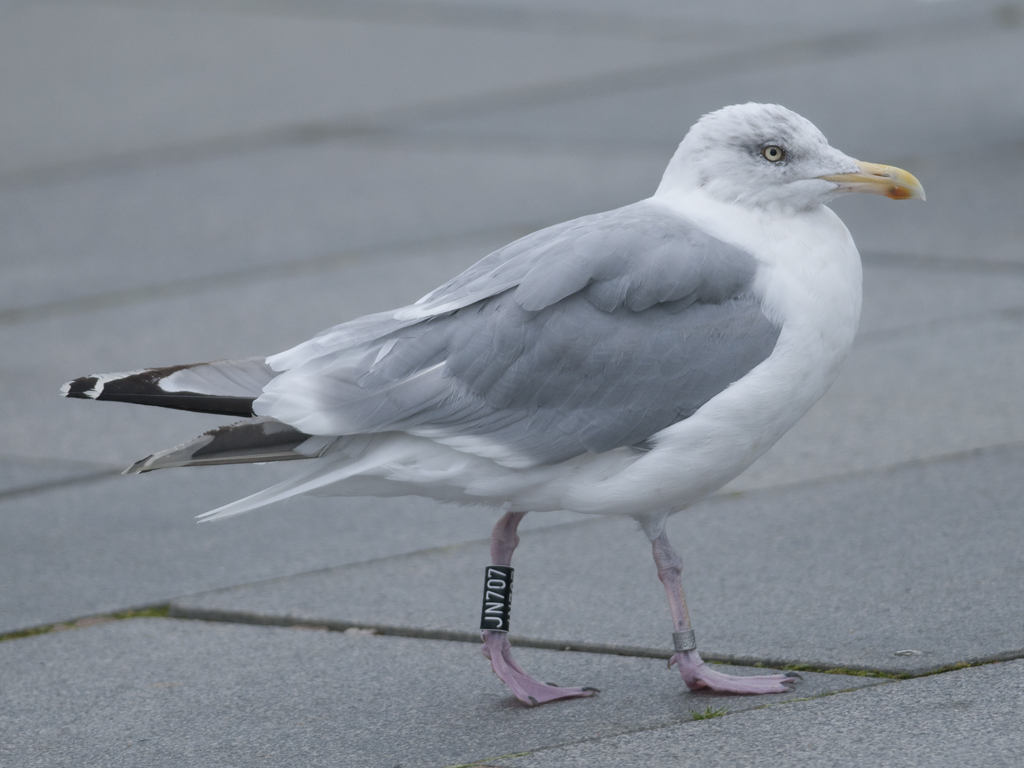
The Great Black-backed Gull is the first we have from this region but the Herring Gull is our second. Our first was the 18 year old, who this spring turned 19, and returned to Bergen 15th of July. We end this post with a picture of the 19 year old Herring Gull born in the same area as the 2012 model.

JN707 showed up in the park 15th of July and have since been seen at a regular basis.