Showing posts with label herring gull. Show all posts

Oct 9, 2012

Two gulls from northwestern Norway


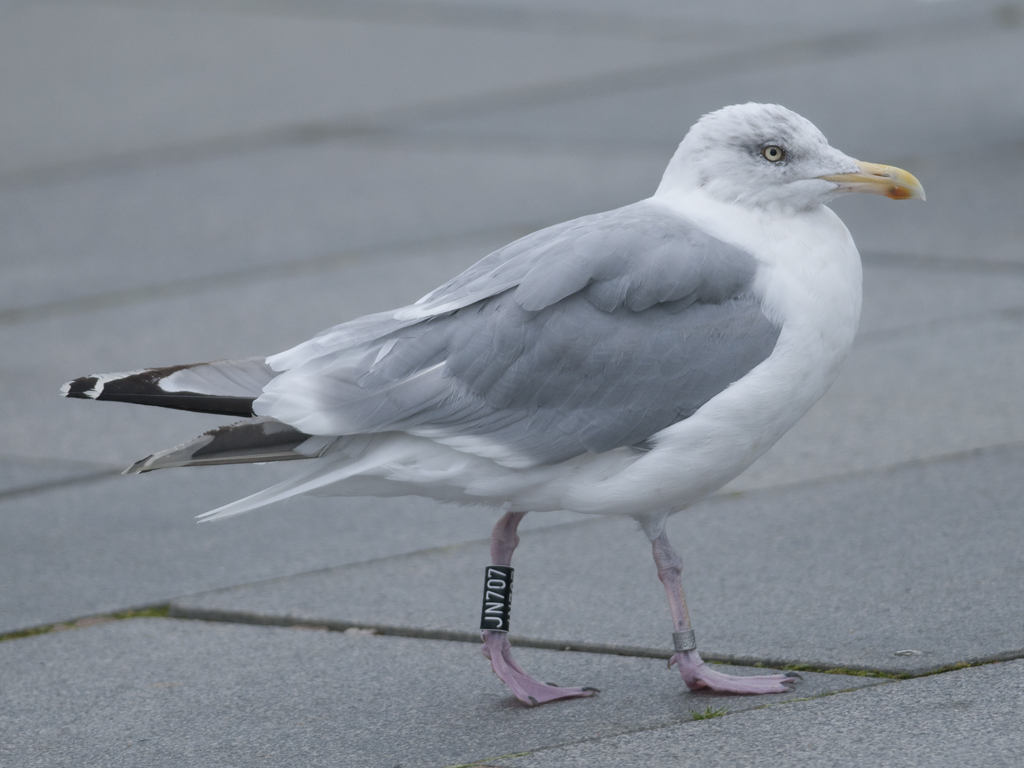
The 26th of September (This post is published after some delay) was spent on the western islands looking for eastern rarities. The first thing we did was feeding out a bag of bread and start to scan gull feet for color rings, once a gull addict always a gull addict. It did not take long before the first Herring Gull (Larus argentatus) with a black JN was spotted. It was ringed on the island of Fedje earlier this spring, so this one was quite ordinary. The next one was much better a fact we knew right away because it was a 1 cy Great Black-backed Gull (Larus marinus) which we have ringed only a few of this year. We suspected that this was the ringing work of Ingar Støyle Bringsvor (blog is in Norwegian). When the number was typed into the database well at home our suspicion proved to be correct. The eastern rarities was absent but this gull made our day.

JP954 was ringed in a breeding colony at Sand in Møre og Romsdal concil 176 kilometres north of where it feed well on our bread.
Well back to the urban sites we used the leftover bread to see if any new gulls had arrived. The first one to show up behaving very aggressively towards the other was a Herring Gull with a black unkown ring to us. The database was quickly accessed through the phone and indeed this was also ringed by Ingar Støyle Bringsvor!

J4743 was ringed at the island Runde which is one of Norways most famous seabird colonies. 


Wing and tail pattern for J4743

The Great Black-backed Gull is the first we have from this region but the Herring Gull is our second. Our first was the 18 year old, who this spring turned 19, and returned to Bergen 15th of July. We end this post with a picture of the 19 year old Herring Gull born in the same area as the 2012 model.

JN707 showed up in the park 15th of July and have since been seen at a regular basis.


May 3, 2012

Latest activities and a Mew Gull that surprise us

There have been some time since our last post on this blog. The reason is not that we have stopped ringing gulls, rather the opposite the effort have been increased. In the one and a half month since the last post we have been focusing on ringing the Lesser Black-backed Gulls (Larus fuscus) breeding on the roofs in the city center of Bergen. At time of writing we have ringed 9 adults in urban Bergen and read seven of the nine adults ringed in 2011. The return rate are very impressive which inspire us to ring more. In addition to the urban ringing we started to do catching in a mixed colony of Herring Gull (Larus argentatus) and Lesser Black-backed Gulls in an industrial area 17 kilometers west of Bergen. So far this have resulted in 21 Herring Gulls and 5 LBGs. We have also had three very interesting readings of LBG's in this colony. One was ringed in Pitsea, England by Paul Roper's group, the second was ringed in Faro, Portugal after it was rehabilitated by the RIAS group. The third was a gull ringed as a chick 280 kilometers to the south outside Lista southwest in Norway. This bird had only been seen earlier in Algeria! We will write more about the work in this colony later.

Lesser Black-backed Gull F016 have returned to the breeding colony thanks to the RIAS rehabilitation centre in Faro, Portugal.
Today the the first 1Y Mew Gull (Larus canus) ringed in 2011 was read at River Severn, Gloucester, England. The special about this bird is that it was one of the easiest we ever have caught. We we gave out bread on a warm day in end of July 2011 this bird was almost running between our feet. We picked it easily up and put on a ring even though we expected close to zero probability that this bird would give a reading. The bird was very small and had a head and bill measurement of only 82 mm and body mass of 285 gram. When we released it it came right back to us begging for more bread. It remained in Bergen for about a week and continued to show the same unafraid behavior. This is the second of our first winter Mew Gulls to be read in Gloucester area the other is summarized here. Thanks to John Sanders for finding and reporting the this bird!

Mew Gull J9R6 was begging for more bread minutes after ringing and we are very pleased that it survived and hopefully will come back to breed on a roof in Bergen city center.

Mar 11, 2012

Ringing pintails and waiting for the Herring Gulls

After returning from Morocco in mid February the number ringed gulls is dangerously close to zero. The reason for this is partly the mild weather and a Peregrine sitting on the city hall building close to the city centre lake making the gulls nervous. The Peregrine usually hunts for pigeons, but when it hunts all the birds including the gulls fly in panic. We have only seen it taking a Mew Gull once and that was close to the place where the gulls spend the night during autumn.

In addition most Herring Gulls seem to have left Bergen. The max count of Herring Gulls in Bergen city in February was only between ten and twenty. We speculate that the reason for this movement is the Norwegian spring-spawning herring (Clupea harengus) which spawns in February-March outside the coast of Møre 200 kilometres north of Bergen. Sightings of the gulls ringed this autumn supports this. Three of these gulls have been seen in the Møre area between 13th of February to 23rd of February. These numbers are not enough to say something exactly but it's interesting. This map summarise the movement of the Herring gulls in January and February.

Movement of Herring Gulls ringed in Bergen (including one ringed some kilometres north west of Bergen in January) during the autumn (n=102). In addition to the sightings shown one was also seen in The Netherlands. All sightings are in January and February 2012.


IDLast seen in BergenDate of recovery, site
JN63207.01.1217.02.12, Sandhavn, Møre
JN64604.01.1223.02.12, Måløy
JN67307.01.1213.02.12, Sandhavn, Møre
JN70127.01.1220.02.12, Milde, Bergen
JN63506.11.1114.02.12, Karmøy
JN67217.12.1104.01.12, Kristiansand
JN62701.11.1125.12.11-12.01.2012, Noord-Holland, NL
When the Herring Gulls have left the city centre lake the Mew Gulls has taken over. In mid February over 600 individuals was counted here.

The last month our activity has manly been reading rings and ringing some ducks like these Pintails and a couple of Wigeons (Anas penelope). Only 15 Northern Pintails (Anas acuta ) have ever been ringed in Norway. It will be interesting to see if one of them can produce a recovery. There is only one recovery of a Norwegian ringed Pintail. This was also ringed in Bergen during winter and shot in Scotland three years later.

Adult male ringed 19th of February 2012First winter female ringed 8th of March 2012

The first winter female ringed 8th of March 2012.

Adult male ringed 19th of February 2012.

Jan 18, 2012

Ringing summary for December 2011

In December we ringed a total of 33 gulls. Most Herrings but two new Black-headed Gulls was nice bringing the year total up to 11.

Species1YSub adultAdult
Mew Gull238
Herring gull936
Black-headed Gull002
SUM11616

Dec 19, 2011

Ringing summary for November 2011

In November we ringed a total of 62 gulls. Most Mew Gulls (33) but not far behind Herring Gulls (26). The highlight of the month was the 1Y Iceland Gull caught on the 27th. This Iceland Gull is the second to be equipped with a ring in Hordaland county. Another highlight was the Estonian Mew Gull controlled on the 22nd. This is the third Estonian Mew to be controlled in Norway.

Species1YSub adultAdult
Mew Gull2535
Herring gull2033
Black-headed Gull101
Iceland Gull100
SUM4769

A map summarising all Estonian Mew Gulls found in Norway.
Black: Found dead in Kopervik south of Haugesund in February 1933
Red: Controlled in the city centre lake in Bergen January 1990
Blue: The one we controlled 22nd of November 2011.
All are ringed as pullus in Estonia and controlled in Norway their first winter.


Iceland Gull J8Y6 the 27th of October. Photo: Lars Ågren

Dec 8, 2011

Oldtimer from Neartic and Herring Gull ringed in UK

3rd of December the returning Ring-billed gull (Larus delawarensis) was rediscovered. It was spotted by Alf Tore Mjøs who is responsible the majority of the records of this species in Bergen. The Ring-billed Gull found today has spent the last 19(!) winters in Bergen. It has not been ringed but a miscolouration on one of the primaries make it possible to recognise this individual. Our plan is of course to put a plastic ring on this beautiful bird, but experience from earlier years have shown that it can be difficult due of it's feeding habits. This individual have never been seen taking bread in the city center lake. The only observations of it outside it's resting places are at the famous fish market in Bergen (Fisketorget) outside a kebab snack bar and at an other snack bar on the other side of town. Our returning Neartic fellow may be particular in it's feeding habits and has to tempted it with a delicious (warm) Shawarma.

Dates for the first observation of the old faithful Ring-billed Gull:
03.12.201112.12.201017.12.200912.12.2008
04.12.200706.12.200606.12.2005
14.11.200224.11.2001

Ring-billed Gull resting on the pier in Store Lungegårdsvann, Bergen

The city of Bergen have 15 records of Ring-billed Gull. The faithful one is of course counted as one. Bergen can therefore make a show of having half of all records of this species in Norway. Two individuals ringed in Bergen have also been recovered and are the only recoveries in the Norwegian ringing scheme. One of these individuals was read in a breeding colony in Newfoundland which shows that regular migration from Nearctic to Western Paleartic is possible for this species. We do not know anything about our returning individual but trans Atlantic migration is the most probable based on ringing recoveries.

The individual read in Newfoundland was ringed in Bergen January 1990 and read in field by Bruce Mactavish in Newfoundland October 1990. This is 3900 kilometers from it's ringing place! The individual recovered on Iceland was ringed in November 1983 and shot in Iceland April 1990 (The Norwegian Bird Ringing Atlas 2003). Both birds was ringed by Alf Tore Mjøs.

The 3rd of December we also found the first ever Herring Gull ringed in United Kingdom in Hordaland. It was spotted in a industrial area the first day, and on Sunday (4th of December) it was feeding on bread in the city center lake. It was ringed by North Thames Gull Group the 14th of February 2009 at Pitse Landfill in Essex UK. Since it was ringed in winter the subspecies is most certain a argentatus which was wintering in UK. A map can be seen on the website of North Thames Gull Group

Herring gull NGOT probably a male judged by it's large size in the city center lake 04th of December

Thanks to Frode Falkenberg, University of Bergen and Alf Tore Mjøs at the Norwegian Ringing Scheme, Stavanger Museum for valuable information on the occurrence of Ring-billed Gull in Bergen.

Nov 12, 2011

Ringing summary for October 2011

In October we ringed a total of 70 gulls. Most Herring gulls which were our main target this month. Top of the month was of course the Glaucous Gull which was ringed 13th of October. It was only present in Bergen one day after ringing and we have unfortunately not had any readings of it yet.

Species1YSub adultAdult
Mew Gull2811
Herring gull2296
Black-headed Gull101
Glaucous Gull100
SUM52108

Glaucous Gull JN666 in Bergen 14th of October

Oct 31, 2011

From Russia with KF87

Today (31st of October) we found the first ever Herring Gull with a Russian color ring in the city centre of Bergen. It was a 1Y gull and when giving it bread we were able to get quite close and get some nice shots. However, due to daylight saving it's almost dark here at 60 degrees north around four o'clock which may show in the pictures. The bird is probably a new arrival of the day, because this weekend we spent many hours both on Saturday and Sunday ringing Herring Gulls in urban Bergen without seeing this white Russian. We do not know where it's ringed yet, but a sms to Morten Helberg who also have read Russian Herring gulls said that it's almost certain ringed in Kandalaksha in the inner part of Kandalaksha Gulf in the White Sea around 600 km south of Murmansk. The distance travelled is the largest distance we have recorded of a Herring Gull found or ringed in Bergen, 1513 km, but this may change when getting the correct ringing data.

KF87 in Bergen. Note that all scapulars are juvenile and not moulted. Other Herrings in Bergen have at least started renewing the scapulars and mantle feathers. Malling Olsen and Larsson (2003) describe this delayed moult in birds with northern origin. Just to compare see the picture below of a Herring Gull where most scapulars are moulted.

JN617 have as most Herrings in Bergen this time of year moulted the majority of scapulars

KF87 with spread wings


KF87 is most likely ringed in Kandalaksha in Russia

Oct 14, 2011

Ringing of Glaucous Gull and more visitors from north

After an unsuccessful attempt to catch the Glaucous Gull yesterday we had a new go during our lunch break today (13th of October). When we came to the city centre lake there was no white winged gull to see, we searched the roofs, feed out two or three fresh bread and waited but the bird seemed to have disappeared. We had seen worrying headlines in the newspaper in the morning that a festival had opened the night before and used huge amount of fireworks. This seemed a likely explanation of the disappearance and we concluded that we had been happy to just see this huge white winged gull. By way of consolation we catched two Herring Gulls and got a new reading of a Mew Gull ringed by Nils Helge Lorenzen in Tromsø. When we looked this Mew Gull up in the database we saw that it was ringed just eight days earlier, which means that it has travelled the 1200 kilometres in the shortest time we in Bergen have recorded.

This 1Y Mew Gull (J7C9) migrated the 1200 kilometres from Tromsø to Bergen in eight days

In the evening we decided to just grab a few Mew Gulls at Tveitevannet, a lake in an urban area south of Bergen. When we went down the path the first sight that met us was a huge white gull sitting between the Mew Gulls. The Glaucous Gull was still present in Bergen! Other people feeding the gulls had also noticed this large white gull because it had dominated the whole feeding place and had chased and stolen food from the smaller ones. We also saw it was possible to come quite close to it and when feeding out fresh white bread we were able to catch it. This is the first ringed Glaucous Gull in Hordaland county ever and we believe there have been just a few ringed in Norway south of Trondheim. When ringing and measuring this lovely bird we both agreed that it must be very big, but since none of us have any experience with this species it's difficult to say what kind of sex it might be. We took blood samples as we do for all our gulls so a DNA analysis will give us the correct answer later. It will be really exiting to see if it is observed elsewhere or if it will stay in Bergen the rest of the winter.

The Glaucous Gull minutes before it was captured and ringed


Wing of Glaucous Gull JN666.Head of Glaucous Gull JN666.

After our white winged friend had got it's freedom again we decided to explore a new possible place for reading and catching gulls - the landfill used by the entire Bergen city in Rådalen. This site has not been used as a gull site before since most garbage are burnt here, but a guy working at the place gave us a tip that there are gulls and they flock around the organic dump. Today the organic dump was not to crowed with gulls. Only a handful of Great Black-backed Gulls and 30-40 Herring Gulls, but one of the Herrings was ringed and paid for the effort of driving here. It turned out that this one also was ringed outside Tromsø as a pullus this spring by Nils Helge Lorenzen.

1Y Herring Gull J2400 ringed right outside Tromsø as a pullus 1220 kilometres from Bergen

When we opened our mailboxes well at home we also saw a message saying that one of our Bergen ringed 1Y Mew Gulls had been seen right outside Stavanger. This is our third 1Y Mew Gull observed in the same area. A map can summarize the day.

Red line: Mew Gull J7C9 and Herring Gull J2400 both ringed in Tromsø. Blue line: Mew Gull J6K3 ringed in Bergen and read in Sandnes 170 kilometres to the south

Oct 5, 2011

Ringing summary for September 2011

In September we ringed a total of 104 gulls. Most of them 1Y Mew Gulls which was really easy to catch on rainy days. 11 1Y Lesser Blacked-backed Gulls was also ringed before they migrated southwards. The number of Black-headed Gull is still low in Bergen this autumn. Our max. count is only 12 which explains the low number of ringed of the species this month. An urban ringed Great Blacked-backed Gull was our first, even if it was a very small one. The numbers is summarized like this:

Species1YSub adultAdult
Mew Gull7703
Lesser Blacked-backed Gull1100
Great Blacked-backed Gull100
Herring gull721
Black-headed Gull101
SUM9725

JC3K hopefully in Spain or Morocco now

Sep 21, 2011

Ringing summary for August 2011

A bit delayed, but here are the ringing summary for August. As table shows our focus has been 1Y Mew Gulls, most of these have been caught in Byparken (the city centre of Bergen) and Tveitevannet (a lake in one of the suburbs of Bergen).

Of the 26 1Y Mew Gulls caught the 20th of August weekend 53 percent was read in either Byparken or Tveitevannet a later date. After three weeks (the 12th of September weekend) 35 percent of the birds was still present and after one month (the 17th of September weekend) only 2 percent was present. The ringed birds are leaving the area and others arrive.

Our numbers for August are as follows:
Species1YSub adultAdult
Mew Gull4142
Lesser Blacked-backed Gull100
Herring gull521
Black-headed Gull001
SUM4764

Aug 24, 2011

18 year old Herring Gull

This evenings quick visit to the park in the city centre of Bergen gave us the opportunity to put plastic ring on our oldest Herring Gull (Larus argentatus) this year. We first saw it standing a bit outside all the first and second year Herrings and got really interested when we saw it was ringed on right foot instead of the left. Alf Tore Mjøs who has done a lot of the ringing in Bergen in the end of the 1980's and 1990's always put the ring on left foot. In addition the ring look like it was quite old due to wear. After some time we got hold of it and and gave it a black plastic ring with JN707 inscription. We did all our measurements and took standard pictures of wing and head. The excitement was high when we opened the Ring Access program and punched in the number and the result said that it was ringed as a pullus in 1993 in Valderøy, Sunnmøre which is 240 kilometres north of Bergen. A bird ringed as a pullus makes it even more valuable.
The bird was ringed at Valderøy 22.06.1993 240 kilometres north of Bergen.

P10 and P9 are unmoulted and from last year. P8 (not showing on picture), P7, and P6 are growing. The first secondary have also been renewed. A moulting score of 60%.

Head of our 18 year old friend.

We also did a nice reading of a Herring gull ringed with white JA ring. Large gulls ringed with JA was the first color ringing project in Bergen. This JA39 was ringed as a 1Y in 18th of March 2004.

Aug 21, 2011

Ringing summary for July 2011

J7Y0 nests on top of the physics building at University of Bergen.
In July we concentrated the effort of catching as many adult gulls as we could. Most of them were Mew Gulls (Larus canus) since these are the easiest species to catch. However, we also used many hours of trying to get as many adult Lesser Blacked-backed Gulls (Larus fuscus intermedius) as well. These are of special interests because they have become urban breeders in the city centre of Bergen. We first observed this nesting strategy in 2007 when one pair nested on the Science building at University of Bergen. This year the number of roof-breeding Lesser black-backed gulls (LBG) is probably closer to 20 pairs. The problem with LBG's is the time needed to catch one individual which our July number of this species indicate. On the other hand none urban breeding adult LBG's has ever been ringed in Bergen and to get information on survival and future breeding behaviour can be very interesting! The first Black-headed Gull was ringed on the 26th of July two weeks after the first individual arrived. See the blog post The black-headed gulls are back.

Our numbers for July are as follows:
Species1YSub adultAdult
Mew Gull1728
Lesser Blacked-backed Gull107
Herring gull021
Black-headed Gull010

We will come back with a blog post on our readings and controls later.