Nov 23, 2012

Anza delivers again

Yesterday evening the plan for this day was already set. Agadir beach in the morning and the rest of the day in Anza. We followed this plan and got awarded with around 130 readings of Lesser Black-backed Gulls (Larus fuscus).  Some of these are the same as yesterday, but not as much as expected. The turnover of gulls in Anza is large and we think that even after 22 hours spent in Anza, tomorrow will give us new birds. We have summarized the Norwegian birds and we have got a total of 55 different LBBGs! Two of todays highlights were a leucistic Lesser Black-backed Gull and the long awaited own ringed LBBG. 10 minutes before dusk J3Y5 was sitting in the dirty water coming out of the fish factory. This bird is ringed as a pullus in 2010 in our monitoring colony at Lyngøy in Hordaland. It was also seen in Blaringhem in France by Harry Vercruijsse earlier this year.

Leucistic Lesser Black-backed Gull
905N from France


JV4C ringed as a first year bird in Kolbotnvannet, Norway


J0K6 ringed as pullus in Lindesnes, Norway has lost a foot

5.M is one of 16 different birds we have read from this project.


J3Y5 the long awaited own ringed LBBG from Lyngøy


Nov 22, 2012

Crazy day in Anza

The first day in Agadir started before dusk and ended in dawn after gull watching in 11 hours. We stared on the beach in Agadir and quickly got ten readings before people, and dogs started their morning  exercise. The next 10 hours was spent in Anza where the gulls was numerous today. In total we read around 140 different Lesser Black-backed gulls (Larus fuscus) including 39 from Norway. One of the highlights was JU04 which we also saw in Anza this spring and found in May at our local site on the island of Fedje. Today this bird was once more sitting in Anza eating the fish remains from the fish factory in Anza. Hopefully tomorrow will give us even more readings. We end this post with some pictures.

T.4 probably from The Netherlands

JH9N ringed by Morten fuscus Helberg in Mandal this summer.

V4TC ringed by Pedersen in Denmark

Some are more colour full than others like this one, E and F85

1U9:C the ringing country is unknown for us

Nov 20, 2012

Finally arrived in Anza

After 16 hours of travel from Bergen via Oslo to Marrakesh and the two hours drive over the High Atlas to Agadir we finally arrived in Anza, Agadir. Here we could enjoy thousands of gulls. We arrived 30 minutes before sunset and could see the huge swarms of gulls over the fishing port. When we arrived in Anza we estimated the number to be between 10.000 - 15.000 gulls, impressive! We put up the telescopes and it did not take long before we had the first ringed Lesser Black-backed gull (Larus fuscus). It was a white ring probably ringed in France. After it became to dark and we had to drive back to Agadir. Now we are really looking forward what tomorrow can bring.


Oct 9, 2012

Two gulls from northwestern Norway


The 26th of September (This post is published after some delay) was spent on the western islands looking for eastern rarities. The first thing we did was feeding out a bag of bread and start to scan gull feet for color rings, once a gull addict always a gull addict. It did not take long before the first Herring Gull (Larus argentatus) with a black JN was spotted. It was ringed on the island of Fedje earlier this spring, so this one was quite ordinary. The next one was much better a fact we knew right away because it was a 1 cy Great Black-backed Gull (Larus marinus) which we have ringed only a few of this year. We suspected that this was the ringing work of Ingar Støyle Bringsvor (blog is in Norwegian). When the number was typed into the database well at home our suspicion proved to be correct. The eastern rarities was absent but this gull made our day.

JP954 was ringed in a breeding colony at Sand in Møre og Romsdal concil 176 kilometres north of where it feed well on our bread.
Well back to the urban sites we used the leftover bread to see if any new gulls had arrived. The first one to show up behaving very aggressively towards the other was a Herring Gull with a black unkown ring to us. The database was quickly accessed through the phone and indeed this was also ringed by Ingar Støyle Bringsvor!

J4743 was ringed at the island Runde which is one of Norways most famous seabird colonies. 


Wing and tail pattern for J4743

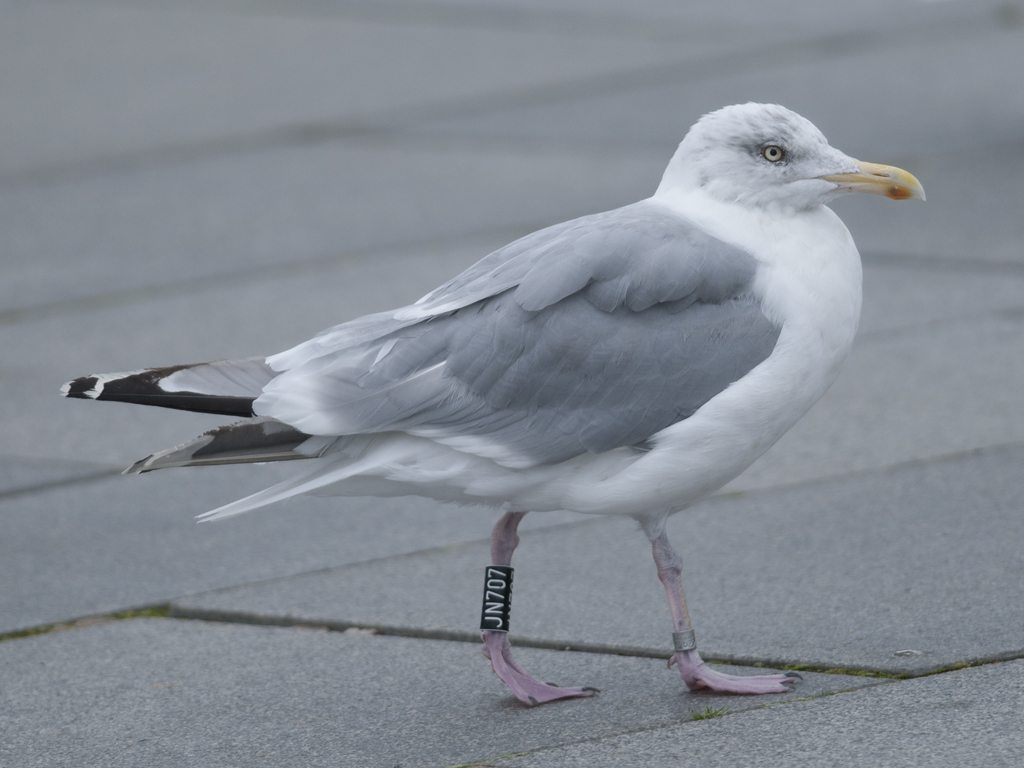
The Great Black-backed Gull is the first we have from this region but the Herring Gull is our second. Our first was the 18 year old, who this spring turned 19, and returned to Bergen 15th of July. We end this post with a picture of the 19 year old Herring Gull born in the same area as the 2012 model.

JN707 showed up in the park 15th of July and have since been seen at a regular basis.


Sep 30, 2012

Mediterranean Gull in Bergen

A really rain full weekend here in Western Norway ended with the forth ever Mediterranean Gull (Larus melanocephalus) of the county. Earlier this Sunday we was out on the urban feeding places for gulls to catch first year Lesser Black-backed Gulls and Herring Gulls. It ended with one of each species and we were quite pleased with that when the the conditions were taken into account. After a late afternoon reading gulls in the different urban lakes a last visit was made to the city centre park. The first thing that got our attention was a Mew Gull (Larus canus) ringed with a white ring that we saw was not ours. A picture was taken and we saw that the ring had the number EZ95 and we know that this is probably a bird ringed by Frank Majoor in The Nederlands. We have earlier had four of his Mew Gulls in Bergen and it was really nice to get a new one.

After a gull with to much contrast between scapulars, upper wing coverts and greater coverts was spotted. A first-year Mediterranean Gull. YES! We had been waiting for this species to show up in the city centre park, and there it was. A few snapshots were taken before it took to the wings a flew across the lake heading south. This is only the fourth record in Hordaland county. So far in 2012 there have been around ten different individuals in Norway as a total, but many of these have not been considered by the local rarities committees so this number is not exact yet. In Hordaland these are the previous records, notice that the two first individuals was colour ringed.
  
  •  22.07-06.10.1996, 1 3cy Bergen. Color-ringed (red  H135) in Szeged, Hungary. Was in 09.05.2004 seen in Nyski, Poland.
  • 21.11.1997-23.03.1998, 1 1cy/2cy wintering in Bergen, This one also color-ringed (red  H775) in Szeged, Hungary. This bird was later seen in Suffolk Great Britain, Szege Hungary,  Antwerpen Belgium, Nyski Poland.
  • 17.07-31.07 2012, 1 3cy in Norheimsund. 

Mediterranean Gull (Larus melanocephalus) in Bergen 30th of September.

Mew Gull EZ95 probably ringed by Frank Majoor in The Netherlands

Sep 25, 2012

Our Lesser black-backed gulls move southwards

Unfortunately we do not have picture of JA6V but JA5V was ringed next to it.
Yesterday (24th of September) Paul Veron reports that one of our Lesser black-backed Gull (Larus fuscus) pullus was seen in Guernsey. This is our first reading for a gull in the Channel Islands and very nice that is was a LBBG pullus where the colony of birth is known. The colony where it was ringed is a semi-urban colony at Ågotnes which is a large supply base for the oil industry in the North Sea. The person responsible for the security kindly gave us access to the whole base and on 12th of July the urban ringing team in Bergen (Christian Pedersen, Vegard Finset Fjeldheim and Arild Breistøl) with help of Bent Fjeldheim from Hallingdal ringing group (blog is in Norwegian) entered the area. We ringed 18 Lesser Black-backed (one of these with metal ring only) and 34 Herring Gull pullus this day. As the other colonies we visited this summer the production of Lesser black-backed was not to good, but the Herring gull production was what we think is a normal level. Since this was our first visit to the colony we do not know the production numbers exactly so the production estimates are uncertain. We also have another reading of a LBBG from this colony but this one have so far only moved to the city center park in Bergen.

JJ1V was ringed in the semi-urban colony at Ågotnes 12th of July and seen for the first time in the city center of Bergen 5th of September. The 20th of September it was still present.


Since the Ågotnes colony is close to Bergen and reading with telescope don't seem to affect to birds much we visited the colony four times after ringing. Of the 17 LBBG pullus we ringed with colour rings 11 individuals (64 percent) has survived to fledging which is quite good. The observation in Guernsey was another confirmation of that the few LBBG pullus that fledged actually have survived.

Readings of Lesser black-backed gull pullus ringed in the colony at Ågotnes. JA6V has been seen 1309 kilometres south west in Guernsey and JJ1V in the city centre of Bergen.

A later post will summarise the colony at Fedje island which is a natural mixed colony of Herrings and LBBGs.

Sep 15, 2012

Some news and our first Gray Heron ringed

It's been a while since our last blog post, but our ringing activities are still continuing with the same strength. One of our target species this summer has been the Lesser Black-backed gull (Larus fuscus). The reason for this is mainly because of all observations outside Norway of the few LBBGs (9 adults and 13 1Y) we ringed last year. This year the numbers are much higher and so far we have ringed 79 fully grown LBBGs. The majority have been ringed in the Bergen city center, but we have also widen the horizon and ringed many breeding birds in the non-urban nesting colonies on the islands west of Bergen. In the colonies we visited the breeding success was low but we still managed to ring 59 nestlings in four different colonies. These days are exiting times, we get reports from Texel in The Netherland, France and Spain from birders who have spotted our birds.We are really looking forward to the autumn and winter months for more reports.

At the moment we try to ring as may first-year LBBGs as possible when they come to the parks to feed bread to fatten up for they journey south. The majority are quite easy to catch and we have reached 22 first-years as writing. Today we concluded that we had done a good job when almost every first-year LBBG we could find had a nice black ring around their legs. We therefore got time to ring some other species. One of the species we ringed was a first-year Gray Heron (Ardea cinerea) which was a new species for us. The story behind this bird was that it was found by the road in an island outside Bergen unable to fly and weak probably because of food shortage. It was transport to the friendly vets at Dyreklinikken Vest in Bergen who examined it and and feed it with cod. After a day and a night with care we could release it by a little lake in a park where we often see Gray Herons hunt for sticklebacks. We equipped it with a plastic ring and released it. In less then 20 minutes after release we could see it hunt for food and hopefully it will become strong enough to survive the winter.


The heron ringed with JE01 started to hunt for food shortly after release.


Large beautiful wings

Later we also ringed two first-year and one adult Coot (Fulica atra). The Coot have become a breeding  bird around Bergen in the last 20 years. This makes it extra interesting to ring this years production and the adults.